Ask for a tarp in Ohio and you get a blue sheet in a poly bag marked poly tarp. Ask the same question in Lagos or Mumbai and you get polythene tarpaulin. Ask a container depot in Rotterdam and you get “HDPE tarpaulin, 200 gram”. Three names, one product: a woven polyethylene cloth, coated on both faces.
The name is worth unpacking, because for most buyers it is the only part of the product they ever see before the invoice. “Poly” is not a material specification — polyethylene, polypropylene and polyester all begin with the same four letters, and only one of them belongs in a cover that will sit in the sun for a year. Our polyethylene tarpaulins are the woven-and-laminated type, and this page is what sits between the name and the purchase order: which construction you are actually buying, what each layer is for, and where the cheap versions fail.
One word, four materials
Polyethylene (PE) is the one in a tarpaulin. It is the same polymer family as the film on a pallet wrap and the body of a water tank, and it is what “poly tarp”, “polythene tarp” and “HDPE tarp” all mean. The other two candidates are worse for the job and cheaper to buy:
- Polypropylene (PP) is stiffer and lighter but degrades faster under UV unless it carries a heavier additive package. PP woven bags are everywhere; PP covers are a low-cost substitute that rarely survives two seasons.
- Polyester (PET) is the strongest of the three in tensile and the most dimensionally stable — which is why it is the scrim inside PVC-coated tarpaulins, not inside a poly tarp. It is also the most expensive.
- PVC is a different material class entirely: a coated cloth at two to three times the mass, covered on the materials comparison page.
So when a quote says only “poly”, it has told you the resin family and nothing else. The rest of the specification — weave, denier, coating weight, stabiliser — is where the price difference lives.
The scrim carries everything; the film only keeps water out
A poly tarp is two products bonded together. The scrim is a woven grid of HDPE tape: film is blown, slit into tapes roughly 2.5–3 mm wide, then hot-stretched at a ratio of about 1:6 to 1:8 so the polymer chains align along the tape. That drawing step is what gives a 30-micron-thick tape the tensile of a much heavier solid film.
The tapes are woven at 6 × 6 to 16 × 16 picks per inch, in deniers from 600 to 1,500. Three numbers describe the grid and they are not interchangeable: weave count sets how many load paths cross a given width, denier sets how much each path can carry, and GSM sets the total mass including coating. A 10 × 10 weave in 1,000D is a different product from a 14 × 14 weave in 800D even when the two weigh the same.
This is also why a tear in a woven tarp runs. The rip follows a tape, because the tape is the strong direction and the gap between tapes is the weak one. It is not a defect; it is what a grid does. It is the reason edge finishing and grommet placement matter more than most buyers expect.
Four constructions that all get called “tarpaulin”
| Construction | What holds it together | Typical GSM | Fails first at | Used for |
|---|---|---|---|---|
| Woven + laminated (PE) | HDPE tape scrim, LDPE film fused to both faces | 50–300 | Tear along a tape; grommet edge | General covers, agriculture, freight |
| Woven + coated (PVC) | Polyester scrim, PVC plastisol knife-coated | 475–745 | Coating abrasion; seam; plasticiser loss | Truck curtains, container, structures |
| Cross-laminated (no weave) | HDPE strips laid at 0° and 90°, heat-bonded | 80–250 | Bond line between layers; point loads | Cheap heavy covers, ground sheets |
| Unreinforced film | Blown LDPE sheet, no reinforcement | 50–250 | Any puncture — the tear does not stop | Vapour barrier, drop sheet, lining |
All four appear in search results under the same words, and the price gap between the first and the third is the single most common reason a buyer thinks they were quoted the same product twice at different prices. They were not.
What lamination actually is — and the thumbnail test
Lamination on a PE tarp is an extrusion process: a molten LDPE film is pressed onto the scrim while still hot, so it keys into the weave mechanically and partly penetrates the gaps between tapes. Coating weight is typically 20–35 g/m² per face. That penetration is what makes the cloth waterproof rather than merely water-shedding — a bare scrim passes water through every interstice.
The failure mode to look for is delamination, and you can find it without a lab. Fold a corner hard, press the crease, then look at it: a white line that stays white, or a film that lifts at a cut edge and peels back with a thumbnail, means the bond is marginal. A well-laminated cloth whitens at the fold and returns. This is also the test that separates a 20 g/m² coating from a 30 g/m² coating, which is a difference you will otherwise only discover in year two.
Pinholes are the other tell. Hold a sample up to a bright window and count the light points per square metre; a light cloth with a thin coat shows them across the panel, and every one of them is a leak path once the cloth is under tension.
Layer counts are arithmetic, not strength
Retail packaging sells “3-layer”, “5-layer”, sometimes “7-layer”. The count refers to how many film layers were built up on the scrim: three layers is film–scrim–film, five is double film on each face, seven adds a print or a blackout layer. Each extra film layer adds roughly 15–20 g/m².
What extra layers buy you is pinhole coverage, a smoother print surface and better opacity. What they do not buy is tensile — that comes from the scrim. A five-layer 140 GSM tarp is a weaker cover than a three-layer 200 GSM tarp, and if the two are priced alike, the five-layer one is the marketing product. The number to compare is GSM, then weave, then denier, then coating weight per face.
Cross-laminated: the construction with no loom
Cross-laminated tarpaulin skips weaving. HDPE film is slit into wide strips, laid down in one direction, then a second set is laid across at 90° and the assembly is heat-bonded under pressure. There is no loom, no warp and weft, and no crimp where the two directions cross.
That makes it cheap and fast, and in-plane it is genuinely strong — flat tensile on a cross-laminated sheet can beat a woven cloth of the same weight. What it lacks is the woven crimp that lets a grid absorb a point load, so a sharp corner or a grommet pulls differently, and the layer-to-layer bond becomes the failure line rather than the tape. It is a reasonable product for a ground sheet or a cover that will be weighted rather than tied. It is a poor substitute for a woven tarp on anything that will flutter, and no amount of extra GSM fixes that.
Colour is a specification, not a preference
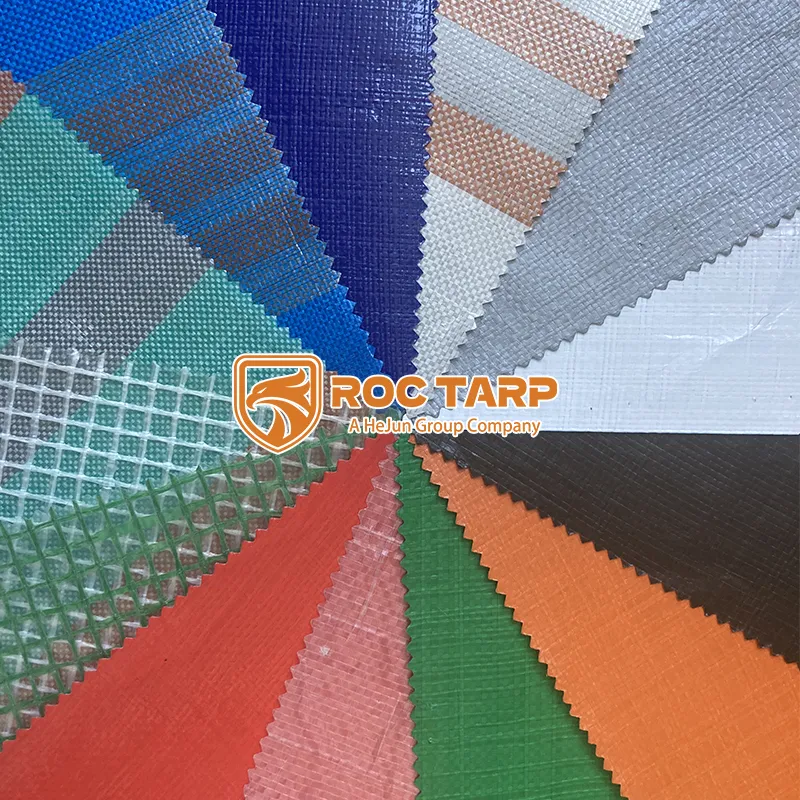
Blue is the default because it is the cheapest pigment and hides dirt. White passes light and is used over crops and on structures where daylight matters — it also shows every mark. Silver, or silver-on-black, is a reflective or fully opaque face: the black side blocks light and the silver side reflects, which is why a black-backed cover runs measurably cooler underneath than a blue one of the same weight. That matters on a steel roof in summer and almost nowhere else. Green reads as tidy on a building site. Printed camouflage is a laminate with a printed film, which is a printing job rather than a different cloth — the printed camouflage covers page covers what that changes about lead time.
What to check on a quote
- The resin, named. PE, and whether the scrim is HDPE or a blend.
- GSM plus weave plus denier. One of the three alone is not a specification.
- Coating weight per face, not total layer count.
- The UV package. Ask for the stabiliser type and the hours to a stated standard, not the word “UV treated”.
- Width and seam plan. Single-piece width decides how many welded seams a finished cover carries.
- Which face goes up. On a two-colour cloth this is not a detail.
Everything on that list is visible in a 20 cm sample, which is why we send them free with freight collect. Where the cloth has to be waterproof by test rather than by construction, the fully coated waterproof range is the place to start; where the scrim is the whole specification, it is HDPE tarpaulins and the density question behind them.