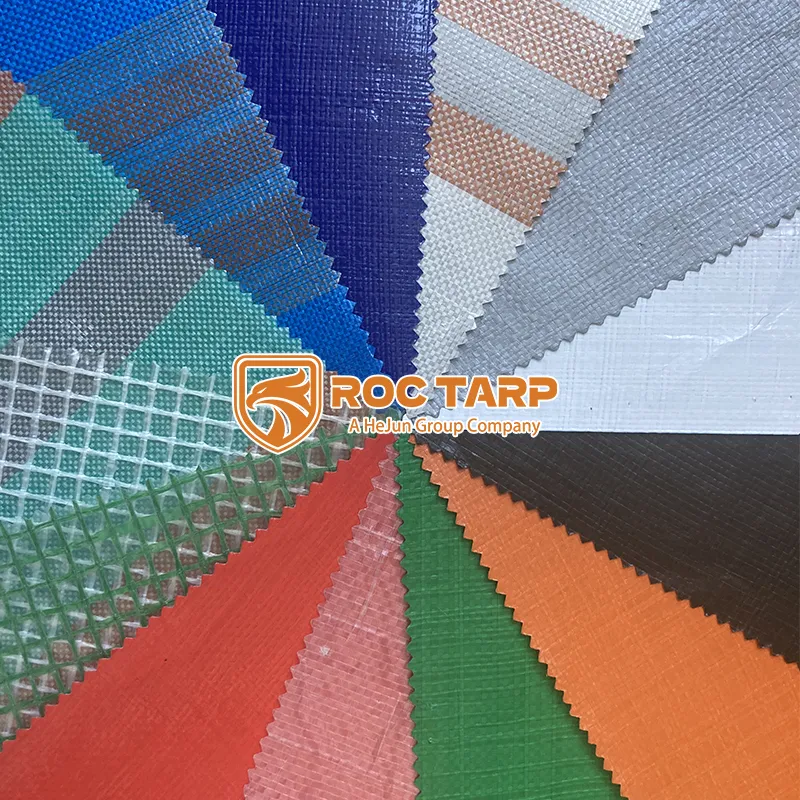
Search for a breathable tarp and you will find two products built to do opposite things. One is sold to a dairy operation sealing a silage clamp, where the entire job of the sheet is that nothing passes through it. The other is sold to a hay grower, where a sheet that seals is worse than no sheet at all. Both get called breathable, and the word is doing different work in each listing.
For hay and silage the question is never which fabric is better. It is which direction the water has to go — out of the stack, or nowhere at all. In a silage or hay cover, that single answer decides the weight, the colour, the seam layout, and whether the sides are closed at all.
Silage: the job is to keep air out, not rain
A clamp or bunker holds its feed value only while the pH stays low and the air stays out. Every pocket of oxygen left under the sheet feeds aerobic bacteria and mould, which burns dry matter and heats the face of the pit. Rain is a secondary problem. The primary one is a cover that lifts, flaps, and pumps air in and out at every seam.
So a bunker cover is specified heavy on purpose: 160–300 GSM in a 5-layer construction, stiff enough to bridge the pit without ballooning, and heavy enough that tyres or gravel bags stay where they were put. Weight has to be continuous along the walls and at every seam — roughly 3–5 kg per metre of edge — because an unweighted cover lifts in the first strong wind and then works like a sail.
In this application a breathable sheet is a defect, not a feature. If your silage cover passes air, it is not doing its job, whatever the listing says.
Hay: the job is to let the stack finish drying
Hay goes into the stack still carrying water it will keep losing for weeks — 12 to 18 % depending on bale type and how long it cured. That moisture has to leave upwards. A sheet that seals the stack turns it into condensation on the underside of the fabric, and the top layer of bales moulds against that wet face.
This is the most common mistake we see in enquiries: a heavy silage specification applied to a hay stack, with all four sides wrapped as well. The buyer has chosen a better sheet for the wrong direction of water movement, and the loss shows up three weeks later in the top row.
“Breathable” means at least three different things
The word covers four quite different constructions, and only one of them is a fabric that passes vapour while stopping liquid.
- A microporous or hydrophilic membrane. A coated or laminated sheet whose pores pass water vapour but not droplets. This is a real product, used on hay sheds and on horse rugs, and it is expensive.
- An open weave — leno or mesh. Air moves freely, and so does rain. Breathable in the plain sense, useless as rain cover.
- Vented panels. A solid sheet with mesh windows or grommeted vents, usually placed high on the side so vapour escapes at the ridge line.
- Woven PE described loosely as breathable. Sometimes the claim refers to the weave before lamination. Once the fabric is coated on both faces it is a continuous film, and the weave underneath has no effect on vapour at all.
That last one is why “breathable poly tarp” is a phrase worth checking rather than trusting. GSM, layer count and coating weight tell you nothing about vapour transmission — which is why a weight chart cannot answer a breathability question.
What a permeable membrane can and cannot do
A vapour-permeable sheet only works while there is a vapour pressure difference across it and a path for the vapour to leave. Laid slack on top of bales, with the edges weighted down, it has neither: the fabric sits on the hay, the air underneath saturates, and the transfer stops. Membranes need to be held clear of the load, which means a frame or a ridge, not a sheet thrown over a stack.
They are also thinner and less abrasion-resistant than coated PE, and their UV life is often shorter than the fabric they are protecting. On a stack that is handled with a loader and opened in winter wind, puncture at the bale corners is the usual end.
The cheapest breathable cover is a top sheet with open sides
Most hay tarps are not breathable at all. They are top-only covers in 90–160 GSM coated PE, overhanging the sides by about a metre, with the sides left open. Water runs off the top, air moves sideways under the eaves, and the stack dries downwards the way it was going to anyway.
This works because ventilation is a property of the assembly, not of the fabric. You do not need a membrane if you leave 60 % of the stack’s surface open to air. What you need is a sheet that sheds rain off the top and stays put in wind — which is a weight and fixing problem, not a breathability problem.
When all four sides have to be closed
Some stacks cannot be left open: exposed sites, straw that will be sold, stacks beside a road. The workable build is a coated PE top sheet overhanging a leno mesh side panel.
The mesh is there to let air through, not to keep rain out — it will not. So it belongs on the lower part of the side, under the overhang of the top sheet, where the top takes the rain and the mesh takes the ventilation. Our leno and mesh range is woven in-house and is normally specified for shade and airflow rather than waterproofing, which is exactly the role here.
Round bales and wrapped bales
Once bales are wrapped in net and film, the wrap is the barrier and the cover is only shade and protection from birds. Breathability is irrelevant — nothing is moving through six layers of stretch film. For unwrapped rounds stacked in the field, the rule is the same as for square bales: cover the top, leave the ends and sides ventilated, and weight the overhang so wind does not peel it back.
What we make, and what we do not
We weave and coat PE from 50 to 300 GSM, in-house, and every coated sheet we make is non-breathable by design — that is what makes it waterproof. We also weave leno mesh, which is breathable and not waterproof. Between the two we can build a covered-but-ventilated stack.
We do not make microporous membranes or non-woven fleece. If your specification genuinely needs vapour transmission through the fabric — a hay shed with no open sides, wrapped bales in a damp climate — we will tell you that neither of our lines does it, rather than quote a coated sheet and let the top row mould.
Three cover types, compared
| Cover | Air movement | Sheds rain | Typical use | Where it fails |
|---|---|---|---|---|
| Coated PE top sheet, 90–160 GSM | Under the eaves only | Yes | Hay and straw stacks, sides open | Seals and moulds if the sides are closed too |
| Coated PE bunker cover, 160–300 GSM | None, by design | Yes | Silage clamp, bunker | Air pockets at seams if weighting is intermittent |
| Leno mesh panel | Free | No | Side vents, shade, refuse loads | No rain protection at all; must sit under an overhang |
| Microporous membrane | Vapour only | Yes | Hay sheds, wrapped bales | Punctures, cost, and it stops working when laid flat on the load |
What to send us
Three things decide the specification: what is under the sheet (silage, square bales, rounds, straw), how long it stays covered, and whether the sides can stay open. Send those with the footprint and we will tell you which weight and which edge build suits it — or that the job needs a membrane we do not make.