Three buyers walk into the same search term. One wants to shade a polytunnel, one wants to keep scaffold debris on site, one wants a cover over hay that will not sweat. They all type “mesh tarp”, they all get quoted, and two of them will be sold the wrong fabric — because this is the one category where the name covers two products that are made on different machines and fail in different ways.
1. One search term, two fabrics
Mesh tarp, net tarp, netting tarp, tarp net, mesh tarpaulin — the trade uses all five for the same idea: a sheet with holes in it. Underneath the words there are two constructions, and they are not interchangeable.
The first is woven. Yarns are interlaced on a loom into a grid, and the grid is held by the interlacing. The second is knitted — almost all high-shade cloth is warp-knitted, where loops are interlocked rather than crossed. Knitting is how you get a 70 or 90 per cent shade factor cheaply, because you can pack loops densely without weaving. Weaving is how you get a grid that holds its shape, cannot ladder, and can be cut anywhere without coming apart.
So the question that sorts the market is not “what size” or “how heavy”. It is:
- “Is it woven or knitted?”
- “What is the shade factor?”
Ask both and the answer tells you which product you are being sold. A reply of “70 per cent shade, knitted” is shade cloth, and it is the right buy for a greenhouse in a hot climate. A reply of “about 30 per cent, woven leno” is this page. What you should not accept is a shade factor with no construction, or a construction with no shade factor — at that point the quote is a guess with a price on it.
One more naming note, because it comes up in enquiries from Asia: the same sheet is sold there as a mono cover, and in Europe as a leno tarp or leno tarpaulin. Leno is the weave, mono cover is the trade name; neither is a brand. If a buyer asks for leno they usually know exactly what they want, which is why the word is worth having on the page even though almost nobody searches for it.
2. How a leno weave holds a grid open
A plain weave cannot hold a wide-open grid. Interlace warp and weft one over one and leave gaps, and the weft slides along the warp the first time the sheet is pulled; the grid closes up in the middle and opens at the edges. Every cheap “mesh” that sags into stripes after a season is a plain weave that was asked to do a leno’s job.
Leno solves it mechanically. The warp is supplied in pairs, and between picks the two yarns of each pair change places — one passes over the weft, its paired end passes under, and they cross back on the next pick. The weft is trapped in the crossing, in a figure-eight, so it cannot slide and the grid cannot close. Nothing is glued, coated or heat-set to hold it: the geometry does the work.
Three consequences that matter when the sheet is in use:
- A cut edge does not unravel. Cut a leno anywhere and the yarn ends stay where they are, because each one is locked by a crossing. You can size a piece in the field with a knife and it will not run.
- A tear does not run. Damage stops at the next locked crossing instead of splitting the sheet in two the way a rip does in a solid film. On a cover that gets hooked by scaffolding or dragged over a load, that is the difference between a repair and a replacement.
- The grid stays square. No blocking, no heat setting, no shrinkage surprise after the first rain. What you measure on delivery is what you have in year three.
This is also what “heavy duty mesh tarp” means on a woven sheet, and it is not what buyers assume. Weight on a mesh is mostly yarn, and a heavier yarn in the same grid gives a coarser, stronger net — not a denser one. If you want more shade you need more coverage, and coverage is a different adjustment from weight. Ask for both; a supplier quoting only one of them is quoting half a specification.
We weave our leno on our own looms, in white and green as standard colours, then cut, hem and eyelet it in the same workshop. That is worth stating plainly because it is unusual: most suppliers selling “mesh tarps” in this size range are converting bought-in knitted net, and cannot change the weave for you. We can — the grid, the yarn and the width are loom settings, which is also why a custom mesh spec is a real production job with a real minimum rather than a sticker on a stock roll.
3. Openness is the specification. Weight is not.
On a solid cover, grams per square metre tells you most of what you need. On a mesh it tells you almost nothing, because the same weight can be a tight grid or a coarse one. Two rolls can both be “120 GSM” and pass completely different amounts of light, wind and rain.
The number that decides the product is shade factor — the percentage of light the sheet blocks, which is one hundred minus its transmission. Our standard leno runs at about 70 per cent transmission, so about 30 per cent shade. That is a light screen, and it is deliberately so: it is the openness that lets a cover sit over something alive, or over a work area, without cooking it or catching the wind.
| Shade factor |
Light through |
What it is actually for |
Made here |
| About 30% |
About 70% |
Windbreak, hail and debris screens, airy covers over hay, plants and stock, work-area shade |
Yes — our standard leno |
| About 50% |
About 50% |
General horticultural shade, car park and patio screening |
No — knitted |
| About 70% |
About 30% |
Greenhouse covering in hot climates, serious plant shading |
No — knitted |
| About 90% |
About 10% |
Full shade, livestock cooling, harsh-sun horticulture |
No — knitted |
Read the table the other way and the boundary is obvious: above about 30 per cent shade the market moves to knitting, and we do not knit. If your spec says 70 per cent, the honest answer is that we are not your supplier for that line, and the second honest answer is that a woven 30 per cent sheet used as a 70 per cent substitute will disappoint you in exactly one season.
One unit note. Where a mesh is quoted by weight at all, the weight applies to the yarn, not the area covered — a 30 per cent shade leno simply has less yarn per square metre than a solid sheet of the same yarn. So never compare a mesh price per kilogram with a solid tarp price per kilogram; on this product the only comparable number is price per square metre at a stated shade factor.
4. What 30% shade is good for — and what it is not
Being clear about this saves a container of returns.
It is good for wind. A 30 per cent screen takes the edge off moving air without building the pressure a solid sheet builds — that is the whole reason windbreaks are open. Use it on the windward side of a yard, a stock pen, a nursery, or a scaffold that has to stay up through a gusty season.
It is good for anything that has to breathe. Hay and bales that sweat under a solid cover, plants that scorch under glass, livestock that need shade but not a stuffy box. A mesh keeps the sun off and lets the moisture out, which is the one thing a waterproof tarp cannot do.
It is good for hail, debris and dust. The grid breaks the impact and contains the pieces — offcuts, insulation, grit, leaves — while letting light and air through, so a work area behind it stays usable. A hole stays a hole instead of becoming a rip, which is why these sheets survive sites that destroy solid covers.
It is good for privacy at a distance, and light diffusion up close. A white leno over a work area or a yard cuts glare and softens shadow without turning the space into a tent.
It is not waterproof, and we will not sell it as one. A 70 per cent open grid passes rain almost as freely as it passes air. The sample sheet in our own brochure says “water-proof” and that word has caused more confusion in this product line than any other: it means the yarn does not degrade in water, not that the sheet keeps you dry. If the requirement is dry, the answer is a solid sheet — the page on where water actually gets in covers that properly — and the correct build for a windy site is a solid cover underneath with a mesh over the top: the mesh takes the wind and the UV, the solid sheet takes the water.
It is also not high-shade horticulture, not a blackout screen, and not a privacy wall at close range — 30 per cent coverage is something you can see through from a few metres away.
One label worth translating, because it is on a lot of retail packaging: “all purpose weather resistant”. On a mesh, weather resistant means the sheet survives the weather — UV, hail, debris, wind — not that the weather stays outside it. That is an accurate description of a 30 per cent woven grid and an inaccurate expectation of a rain cover, and the gap between the two is worth one question before anyone commits to a container.
5. Wind, and why the mesh version stays on
Every solid cover on a frame is a sail. The load it takes rises with area and with the square of wind speed, and it is transferred into the only places that can hold it: the eyelets, the hem and the ties. That is why solid tarps on scaffolding fail at the eyelet line rather than in the middle of the sheet, and why they fail in the first real gust rather than gradually.
A mesh changes the load path rather than the material. Most of the flow passes through the grid, so the pressure difference across the sheet is a fraction of what a solid sheet of the same size takes, and the sheet stops flapping. Less flapping means less abrasion on the frame, fewer shock loads at the eyelets, and a cover that is still on the structure after a season of the weather that took the last one off.
Two practical points, both about the edge, because the edge is where a mesh fails:
- Eyelets need a hem. Thin yarn around a brass ring will pull through under load; a double-folded hem spreads the load into the sheet. We hem as standard, and can sew a rope pocket into the hem for a run of rope or cable — on a large panel that is a stronger fixing than any number of eyelets.
- Spacing is a load decision, not a habit. 24 inches is the default on the perimeter, 12 inches where the sheet is exposed or long, and corners get reinforcement regardless. Tell us the fixing method rather than the number and we will set the spacing to it. The hem, the eyelet and the reinforcement are one operation on our side — see eyelets and finishing.
6. Colours, formats and the sizes people actually order
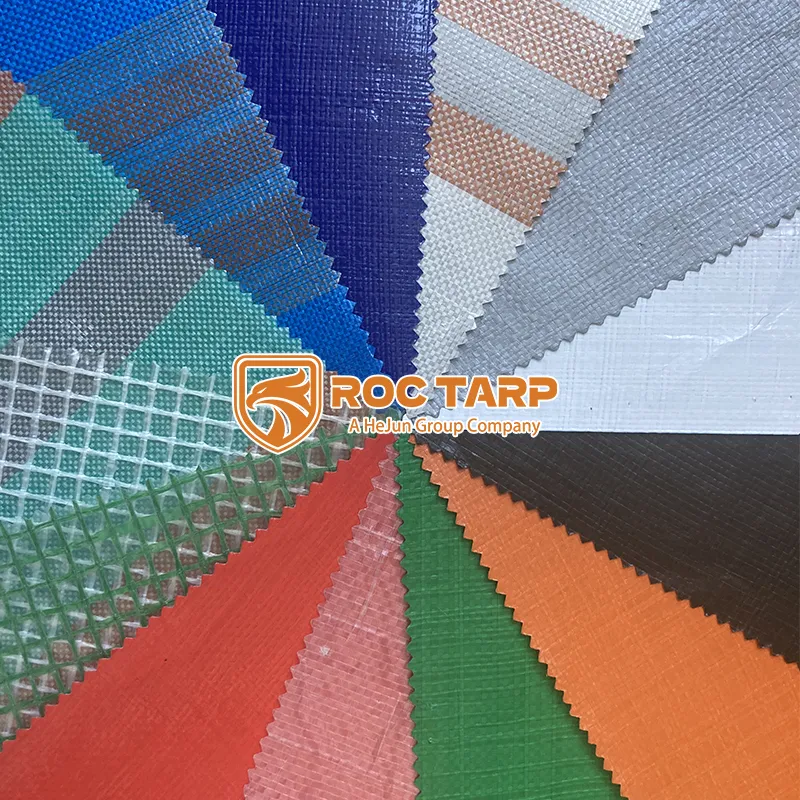
White and green are our standard, and both are transparent weaves — the colour is in the yarn, so the sheet reads as a coloured grid rather than a dyed surface. White maximises diffused light and is the choice over plants and work areas. Green is the trade’s default for shade and screening, and it disappears against foliage, which is why it is the colour most often specified for nurseries and yards.
Black is the biggest colour word on this page and the one that needs care. Almost all black mesh sold in this market is knitted 50 to 70 per cent debris netting, bought by the roll. We can weave black, and it is a normal colour specification, but it will still be a 30 per cent shade woven grid — so if the job is “black netting like the last roll”, we will say so before quoting, because the product is different even when the colour matches.
Tan is a colour specification and is quoted per order. Silver is not available: aluminised shade net is a different material and we do not make it. The same applies to vinyl- and PVC-coated mesh, which is a coated product rather than a woven one.
Format is a separate decision from size, and it changes both the price and the packing:
| Format |
What it is |
How it is quoted |
Typical order |
| Finished sheet |
Cut to size, hemmed, eyeleted |
Per piece, in feet or metres |
6×8, 8×10, 8×12, 10×10, 10×16, 10×20, 12×12, 12×20, 20×20 ft |
| Roll |
Full width, continuous length |
Per roll or per metre |
Buyers who cut their own sizes |
| Cut panel |
Cut to size, no hem or eyelets |
Per square metre |
Fabricators who finish on site |
The foot sizes above are the ones that actually get ordered, because they are the retail shelf sizes in North America — 10×10, 10×20 and 8×12 do most of the volume. We cut to any of them and to sizes that are not on the list; there is no tooling change between one size and another, so a non-standard size costs the same per square metre as a standard one. What does change the price is the format: a roll is cheaper per square metre than a hemmed and eyeleted sheet, and a cut panel is cheaper again.
“Large” and “small” are worth pinning down, because they are relative. A small mesh tarp in this trade runs up to about 8 × 10 ft — a cart, a pallet or a small bay — and a large one starts around 20 × 20 ft, where the sheet stops being something one person handles and the fixing method starts mattering more than the fabric. There is also no separate “outdoor” grade: what changes on an exposed installation is the eyelet spacing and the reinforcement, not the weave.
7. Ordering, minimums, and what we do not make
Minimum order is 5 tonnes, and 5 tonnes per specification for a custom colour, width or mesh — specifications do not combine. On a light open fabric that is a lot of pieces rather than a few heavy ones, which catches people out: five tonnes of solid 200 GSM tarp is about 450 covers, and five tonnes of mesh is many more than that. We quote the piece weight alongside the price so the arithmetic is visible before you commit.
Lead time is about 30 days for a container of standard white or green. Samples are free and you cover the courier — ask for a cut piece rather than a swatch card, because on a woven grid you want to see the openness against the light, not a 10 cm square.
Four things we will not quote, and saying so here is cheaper for both of us:
- Shade cloth at 50 to 90 per cent. Knitted, and a different production line. Buy it from a shade-net specialist; we will not substitute a woven 30 per cent sheet.
- Shade sails, insect netting and aluminised net. Sails need engineered corners and load certification; insect netting needs a mesh fine enough to exclude thrips; aluminised net is a coated product. None of the three is a leno tarp.
- Coated mesh — vinyl, PVC or laminated. Coating a mesh closes the holes or bridges them, and it is a different process from weaving. Our mesh is uncoated by definition.
- Fire-retardant mesh as a stock claim. FR is a formulation property and it is quoted against the standard you name (NFPA 701, EN 13501-1, BS 5867), tested per batch. We will quote it; we will not label a roll as certified without the report.
For the solid version of everything this page does not cover, start with the PE range; for the sites where these sheets are used, the construction pages and the farm pages put them in context. The weaving itself is on the weaving capability page, and rolls are ordered through tarpaulin rolls. If what you actually need is a shade panel rather than an airy cover, the shade tarpaulin page is the same cloth read the other way — by how much light it keeps out rather than how much it lets through.