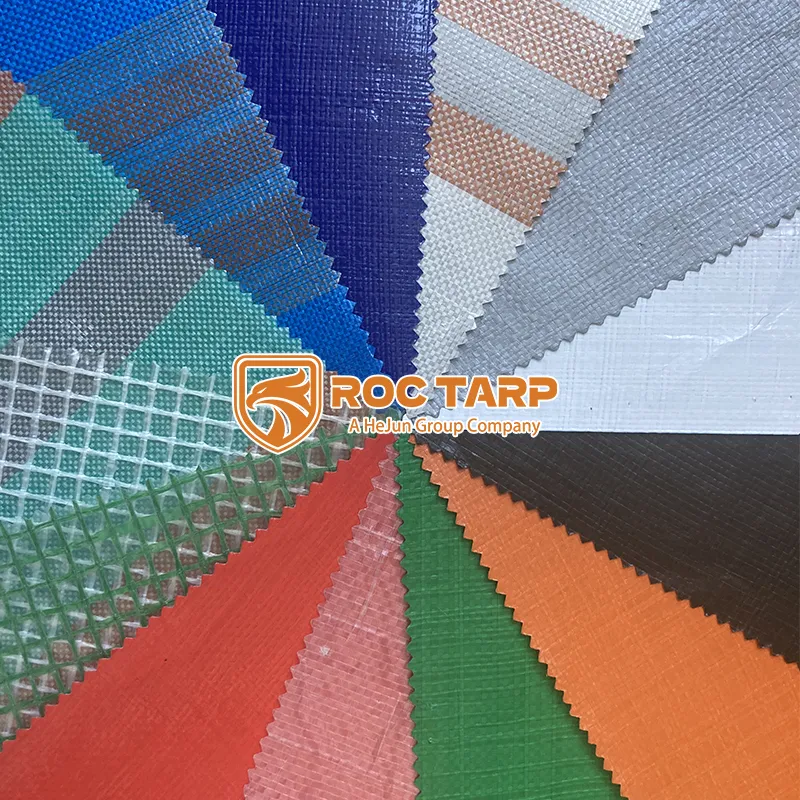
Put a 200 GSM polyethylene tarp and a 610 GSM PVC tarp side by side and the first thing you notice is that they do not behave like the same product at two price points. They behave like two different engineering answers to the same question. One is a light woven grid with a thin film fused to each face; the other is a heavy coated cloth where the coating is most of the mass.
That is why “PE or PVC” is a harder question than it looks, and why the answers online tend to be either a price comparison or a brand preference. Both are useless. The useful version is on the tarpaulin materials comparison: work out which failure you cannot accept, then pick the cloth that fails somewhere else. This page takes the five axes that decide most real jobs and puts numbers on them.
Two numbers that settle most of the argument
Mass range. Woven PE runs from 50 to 300 GSM. Coated PVC runs from 475 to 745 GSM. There is a gap between 300 and 475 that neither material fills, and a supplier who offers you a “400 GSM PE tarp” is describing something other than a woven polyethylene cloth.
Single-piece width. PE is woven and laminated at 2.0 m or 4.0 m. PVC is coated at 3.2 m, 4.0 m or 5.0 m. On a 10 m span that is the difference between two or three welds and five — and on a cover that has to stay watertight, seam count is not a detail.
Both of those feed the third number, which is time: PE is typically about 30 days per container, PVC about 45. The PVC number is longer for a process reason rather than a queue reason — a coating run is set up for one specification, so changing width, colour or GSM means stopping and re-setting the line. Order PE and PVC on the same day and they will not arrive together.
What the extra mass buys
At four to five times the mass per square metre, PVC is not simply “stronger”. It is differently strong, and the differences are specific:
- Tear and puncture. A 610 GSM coated cloth resists a propagating tear far better than a 200 GSM laminated one. Where a PE tarp rips along a tape once a cut starts, a heavy coated cloth usually stops it.
- Blockout. A coated cloth at that weight is opaque. PE is translucent unless it carries a black or silver layer, and even then a bright sun shows through.
- Weld strength and re-weldability. PVC welds into a homogeneous joint; the seam is as strong as the coating. PE welds well too, but the weld is a film-to-film bond over a scrim, and the scrim gap behind it is where a seam eventually leaks.
- Drape and hang. A heavy cloth hangs still. On a side curtain, a marquee wall or a container sheet, that stillness is the whole point — a light cloth flutters, and flutter is what destroys covers.
- Abrasion. The coating takes the wear instead of the yarn. On a truck curtain that is dragged daily, this is the property that decides service life.
What it costs you
None of that is free, and the bill arrives in five places:
Cold. PE stays flexible to about −40 °C. PVC stiffens as it cools and, over seasons, plasticiser migrates out of the compound — the cloth hardens, then cracks at fold lines. A PVC cover that lives outdoors in a cold climate has a finite folding life, and it is shorter than the cloth’s weather life.
Freight. At 600 GSM you run out of container weight roughly three times sooner than at 200 GSM for the same covered area. Buyers who quote PVC by the container of pieces rather than by gross weight discover this at the port.
Repair in the field. A PE cover can be patched with a hot-air gun and a piece of the same cloth by anyone who can hold it steady. PVC needs a temperature-controlled welder and a feel for the material; a badly welded PVC patch is a leak with a border.
Handling. A 10 × 10 ft cover is 1.9 kg in 200 GSM PE and 5.7 kg in 610 GSM PVC. One is thrown; the other is carried by two people and folded on the ground.
Price per square metre. PVC is the more expensive cloth, by a margin that a per-year comparison sometimes justifies and a per-piece comparison never does. If the cover will be replaced seasonally, the cheap cloth wins on arithmetic regardless of quality.
The temperature line, and the trap in it
PVC’s service ceiling is about 70 °C. That sounds generous until you put a dark PVC cover on a steel roof in full sun: surface temperature on dark-coated steel routinely runs well above ambient, and a black or dark green sheet in direct summer sun can approach the limit from underneath. The failure is not dramatic — the cloth softens, takes a permanent set over whatever it is draped across, and the plasticiser starts leaving. Light colours and a reflective face are not cosmetic choices on that job.
PE’s limit is at the other end: −40 °C, which is why it is the material for cold-store work, winter freight and anything that will be folded and unfolded in freezing conditions.
Fire, stated carefully
Neither material is fireproof, and any claim to the contrary should arrive as a test report with a standard number on it, not as a line on a datasheet. The behaviours differ: PE melts, drips and continues to burn; PVC compounds are inherently harder to ignite because of the chlorine in the polymer, but combustion gives off hydrogen chloride, which is corrosive and toxic in an enclosed space. Flame-retardant grades of both exist. Ask which standard, which test method and which report — a compound described as “FR” without those three answers is a marketing word.
The comparison, on the axes that matter
| Axis | Woven PE (laminated) | Coated PVC |
|---|---|---|
| Mass range | 50–300 GSM | 475–745 GSM |
| Single-piece width | 2.0 m / 4.0 m | 3.2 m / 4.0 m / 5.0 m |
| Tear propagation | Runs along a tape once started | Usually arrests at the coating |
| Opacity | Translucent unless black/silver faced | Opaque at weight |
| Cold flexibility | To about −40 °C | Stiffens; plasticiser migrates |
| Heat ceiling | Well above ambient | About 70 °C |
| Seam | Film-to-film weld over scrim | Homogeneous weld, as strong as coating |
| Field repair | Hot-air gun, easy | Needs a controlled welder |
| UV life | Set by the HALS package | Set by stabiliser and plasticiser system |
| Typical lead time | ≈30 days / container | ≈45 days, coating run per spec |
| Cost per m² | Baseline | Multiples of PE |
Two rows in that table are the ones buyers skip. The width row decides your seam count before you have chosen anything else, and the lead-time row decides whether the cover arrives before the season does.
Where each one wins
PE wins when: the area is large and the budget is fixed; the cover is replaced on a schedule; the site is cold; freight is weight-limited; the cover will be repaired by whoever is on site; or the job needs a single piece wider than three metres without a weld in the middle of a span.
PVC wins when: the span is long and the cover has to hang still; the surface is abraded daily, as on a truck and trailer curtain; the job needs true blockout; the cloth has to hold a print; or the installation includes hardware — lacing, keder, eyelets under real load — where a heavier cloth holds the fixing better.
If the answer is still unclear, the question to ask is not “which is better” but “what will this cover die of”. Wind flutter kills light cloth. Abrasion kills coated cloth at the fixing line. Sun kills both, at different rates. Heat kills PVC. Cold kills PVC faster. Price kills PE — because a cheap PE cover that has to be replaced twice costs more than the PVC one it replaced.
Where the two overlap — 200 to 300 GSM PE against the lightest PVC at 475 GSM — the honest answer is that the polyethylene tarpaulins are usually enough, and the PVC range is buying you seam quality and hang rather than a longer life. Above 300 GSM on a woven cloth, the heavy-duty range is the same material pushed to its limit, and the next step up from there is a change of material class, not a change of weight.