Most custom tarp orders fail at the same place: the buyer sends a size, the mill quotes a size, and nobody writes down the six things that actually decide whether the sheet fits. This page is about those six things — and about what we make ourselves versus what your finisher completes.
What actually changes when a tarpaulin becomes custom
A stock tarpaulin is a catalogue item: one weight, a handful of sizes, one eyelet spacing. A custom tarpaulin is a released specification. Between the two sit six variables, and each one moves cost, lead time and the way the sheet behaves in service.
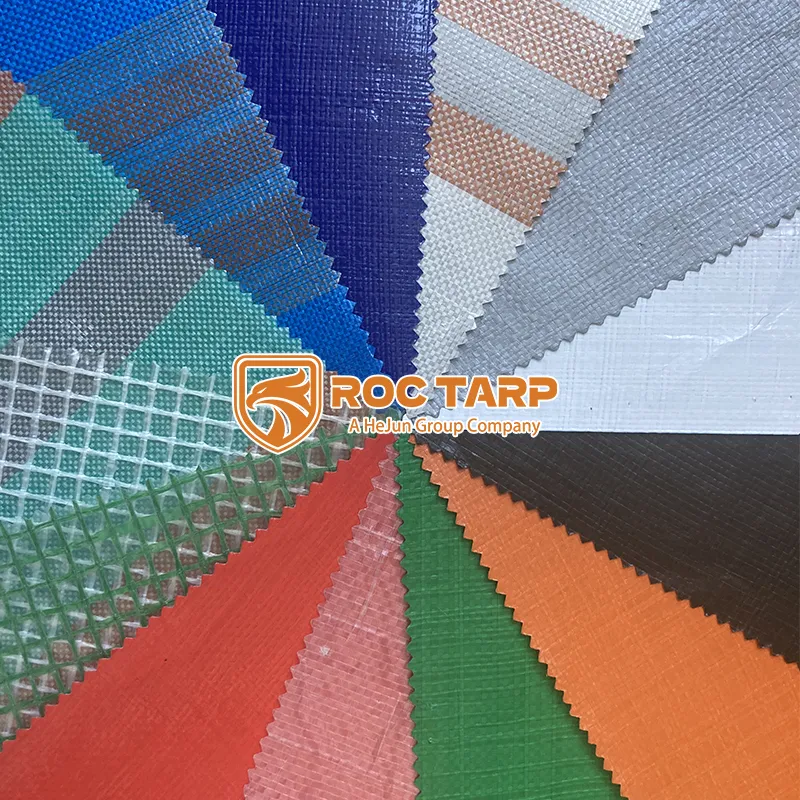
- Fabric and weight. PE from 50 to 300 GSM, or PVC from 475 to 745 GSM. Weight decides tensile strength, tear resistance and how the sheet hangs.
- Made width. The width the cloth comes off the line at — 2.0 m or 4.0 m for PE, 3.2 m, 4.0 m or 5.0 m for PVC.
- Cut length and joins. Anything longer than the made width needs a welded join, and a join is a decision about where it lands on the finished article.
- Edge treatment. A heat-sealed reinforced hem, an eyelet line, or both. The edge is where a tarpaulin cover fails first.
- Eyelet spacing. Closer spacing spreads wind load across more fixing points but adds labour and hardware; 600 mm is a common starting point.
- Packing. Pallet, bale or carton, and how many pieces per unit — usually the detail that decides whether a container loads cleanly.
What we can change, and what stays fixed
Being explicit about the fixed column is what makes a quote comparable. These are the rails we work inside.
| Element | Range or method | What it means for your order |
|---|---|---|
| PE fabric | 50–300 GSM, woven and coated on our own lines | Light covers through heavy-duty sheets from one source |
| PVC fabric | 475–745 GSM, made at 3.2 m, 4.0 m and 5.0 m | Heavier hand, better abrasion, truck and container grades |
| Finished size | Cut to your drawing; welded joins where size exceeds made width | Join position agreed before production, not after |
| Edge | Heat-sealed reinforced hem; eyelets punched to spacing | No stitching anywhere in the edge |
| Printing | Handled as a separate printing process, with its own minimum and lead time | Logo work is scheduled separately from cloth production |
| Minimum order | 5 tonnes per specification | One specification, one minimum — not a blended total |
| Standard lead time | 30 days per container for standard lines; 45 days for PVC | Clock starts at approved specification, not at enquiry |
Sampling is free; you cover the freight. That is deliberate — it keeps the sample honest rather than a paid performance.
Tarpaulin covers without the sewing — where our scope ends
This is the part most suppliers blur, so we will be blunt. We weave, coat, cut, weld and eyelet. We do not sew. No stitched hems, no zips, no elastic edges, no drawstrings, no sewn-in brand labels, no drainage fittings.
That makes us the wrong supplier for a finished retail cover and the right one for the cloth that becomes it. A drawstring tarp, for example, is a sewing product by definition — we can supply the cut panel, the eyelets and the hem, but the channel and cord belong to a finisher. The same applies to a patio tarp cover with a zipped valance, or a furniture cover with an elastic hem.
Where this works beautifully is the tarps and covers trade that brands actually run: we deliver spec-locked panels, cut to the shape, eyeleted on the line you specify, and your own line adds webbing, buckles, zips or branding. You keep the part of the product that carries your margin and your quality signature; we keep the part that needs a coating line and a 31,000 m² plant.
If you are buying finished covers and want one supplier for everything, say so at enquiry and we will tell you straight that the sewing has to happen somewhere else.
The numbers behind a custom tarpaulin quote
No unit prices on this page — they move with resin, freight and specification. But the arithmetic that drives them is worth understanding, because it explains why two quotes for the same size can differ by a third.
- Weight, not area, sets the floor. A 20 × 30 ft sheet in 220 GSM is roughly 12 kg. Five tonnes is therefore about 400 sheets of that one specification — which is why a mixed programme needs several specifications, each with its own minimum.
- Eyelet count is labour. Going from 1 m spacing to 500 mm spacing roughly doubles punching and hardware on the same sheet.
- Joins are a process step. A 30 ft length from 4 m cloth needs a weld; a 20 ft length does not. Same product name, different routing.
- Packing decides freight. Baled sheets load denser than cartons; the difference often matters more than the fabric itself on a full container.
OEM and private label, without a printing line of our own
Logo work is real and we do it, but it runs as a separate printing process with its own minimum quantity and its own lead time — it is not a same-line extra. Plan it as a second schedule, not a checkbox.
What that means in practice: cloth production and printing are approved separately, colour is matched against an approved artwork reference, and the printed goods re-enter the packing schedule after printing. Sewn-in labels, woven tags and retail hangtags sit with your finisher or your packaging supplier, because all three involve stitching or assembly.
For buyers who need the brand on the cloth and the finishing in their own factory, this split is an advantage: the printed panels arrive flat, in sequence, ready to be finished without unpacking a retail carton first.
How a custom order runs
| Stage | What happens | What you receive |
|---|---|---|
| 1 · Drawing review | We read the size, the fixing pattern and the service conditions, and list what is missing | A written list of open questions before anything is quoted |
| 2 · Specification release | Fabric, weight, width, joins, edge, eyelet spacing and packing are frozen in one document | A one-page specification you can circulate internally |
| 3 · Sample | Made to the released specification, not to a catalogue approximation | Physical sample, freight collect |
| 4 · Bulk | Production against the approved specification | 30 days per container on standard lines; 45 days for PVC |
| 5 · Inspection and loading | Count, weight, eyelet spacing and packing checked before the container closes | Inspection record and loading photos |
What to send with the first enquiry
- Finished size, and whether that size is cut size or includes the hem.
- Application and the conditions it has to survive — wind, sun, abrasion, contact with a hot surface.
- Fabric preference, or the weight you used last time and what failed.
- Eyelet pattern: spacing, distance from the edge, and any corner reinforcement.
- Quantity per specification, and how many specifications the order contains.
- Destination port, and whether the goods ship as bales, cartons or on pallets.
If you only have a photo of an existing product, send that. We would rather ask three questions now than rebuild a container later.
Frequently asked questions
What is the minimum order for a custom size?
Five tonnes per specification. A single custom size is one specification, so the minimum applies to that size — it cannot be pooled with a different weight or a different eyelet pattern.
Can you make a drawstring tarp?
No. A drawstring needs a sewn channel and a cord, and we do not sew. We can supply the cut panel with a reinforced hem and eyelets, and your finisher adds the channel.
Can you print our logo on the tarpaulin?
Yes, as a separate printing process with its own minimum quantity and lead time. Artwork and colour are approved before printing, and printed goods re-enter packing after printing.
How long does a custom order take?
Standard lines run 30 days per container and PVC runs 45 days, counted from approved specification. A custom item adds a sample round before that clock starts.
Can you match a sample we already have?
Yes. Send the sample and tell us what you like and dislike about it. We will confirm weight, width and edge method against it and flag anything that cannot be reproduced exactly.
Do you supply finished covers for furniture or machinery?
We supply the cover panels — cut, welded, hemmed and eyeleted. Anything with zips, elastic, drawstrings or sewn seams needs a finisher, and we will say so rather than quote a product we cannot complete.
Can a custom order be combined with stock items in one container?
Yes, provided each specification meets its own minimum. Mixed loading is normal for distributors; it just has to be planned at specification release so packing and loading sequence line up.
Ready to release a specification? Send the drawing, the quantity per size and the destination port to our team, or read how a wholesale and container programme works if you are buying to stock across several specifications. Both routes, and the industries they serve, are set out on the solutions overview.