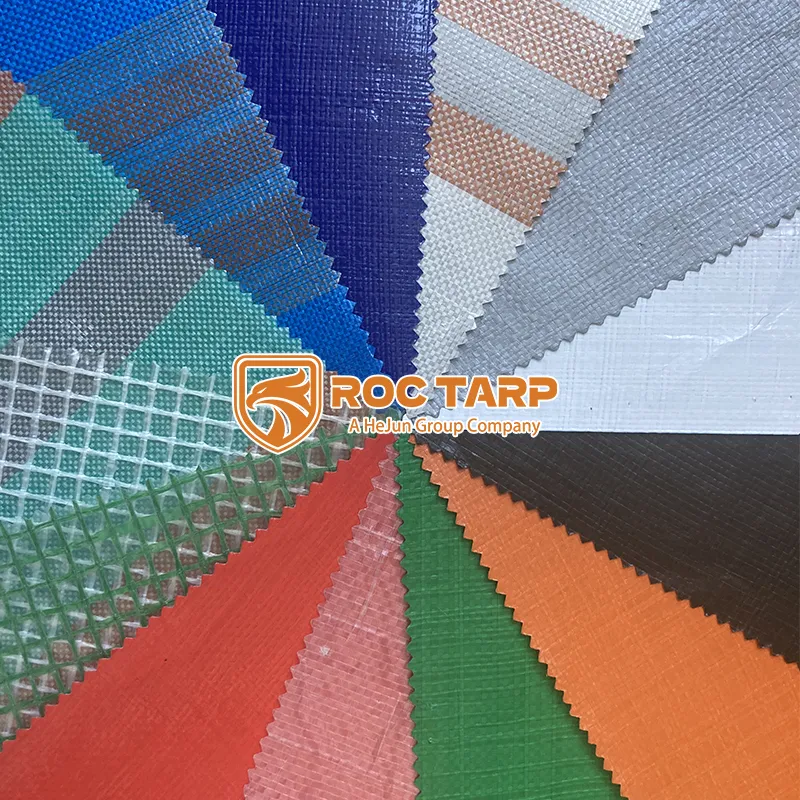
Every other tarpaulin on this site lies down. It covers a pile, a roof, a load, a pool, and gravity is on its side. A fence screen stands up: it is fixed along a vertical run and takes wind across its entire face, all day, for months. That single difference changes what the product is for, how it fails, and what a useful quotation has to contain.
The failure is almost never the cloth. A 150 GSM woven PE sheet will outlast the fixing that holds it, every time. What fails is the eyelet, the cable tie, the top rail, or the post that was never designed to carry a solid sail. So this page is mostly about the arithmetic that decides whether the fence line survives, and about the two jobs — privacy and windbreak — that look the same and want opposite sheets.
1. Four jobs hide behind “fence tarp”
The buyers are not the same and the sheets are not the same. A contractor screening a city centre site wants an opaque visual barrier that satisfies the client and does not fall onto the pavement. A homeowner with a chain link boundary wants privacy without a new fence. A nursery or a soil yard wants a windbreak that slows air rather than stopping it. An event or a sponsor wants a printed face, which is a different process again.
| Job |
What it has to do |
What we supply |
What stays outside |
| Site hoarding / privacy |
Block the view from the road; stay on the fence in wind |
Opaque PE 150–200 GSM, hemmed, eyelets at 12 in |
Posts, frames, installation, fire certification |
| Chain link cover |
Hang on existing mesh without a frame |
PE 150 GSM cut to height, 12 in eyelet spacing |
Cable ties, tension wire, the fence itself |
| Windbreak for plants or soil |
Slow the wind, not stop it |
Leno mesh at about 30% shade |
Knitted 50% shade net — different supplier |
| Printed barrier |
Carry a brand or a message |
Base sheet plus a separate printing process |
Design, and its own minimum quantity |
Those four are quoted differently, so the first useful thing an enquiry can say is which one it is. The rest of this page takes them in the order they cause trouble.
2. The wind load nobody prices: 871 kg on a 6 × 50 ft sheet
Wind pressure rises with the square of speed. In the units the trade actually uses, q = 0.00256 × V² pounds per square foot at wind speed V in miles per hour. Multiply by the area of the sheet and you have the horizontal load the fence has to resist.
| Wind |
Pressure |
Load on a 6 × 50 ft sheet (300 ft²) |
What it looks like on site |
| 30 mph |
2.3 psf |
690 lbf — about 313 kg |
The sheet bellies; ties creak; nothing fails yet |
| 50 mph |
6.4 psf |
1,920 lbf — about 871 kg |
Posts start to lean; the eyelet row is the first thing to open |
| 70 mph |
12.5 psf |
3,760 lbf — about 1,706 kg |
The fence line is now the question, not the sheet |
Nine hundred kilos against a 50 ft run of chain link is the number that ends most arguments. A mesh fence is designed to pass wind through two-inch openings; hang a solid sheet on it and you have roughly doubled or tripled the load on posts that were never sized for it. That is not a reason to avoid a screen — it is the reason a screen has to be specified with the fence, and the reason we ask what wind the site has to survive before we quote a weight.
Two practical consequences follow. First, the sheet has to be fixed at the top as well as the sides: a screen tied only along the bottom and the verticals bellies inward and works its fixings loose in a season. Second, tight is not better. A sheet stretched drum-tight has no give, so the gust arrives at the eyelet as a shock load rather than a pull; a small amount of slack, evenly distributed, is what keeps the row intact.
3. Why the eyelets fail before the fabric does
A 150 GSM PE sheet is about 6 mil of laminated weave. It does not tear in the middle; it tears out — the brass ring pulls through the reinforced patch, or the patch itself peels away from the sheet, and the run opens along the top edge first. Three details decide how long that takes.
Spacing. Eyelets at 12 inches behave very differently from eyelets at 24 inches. At 24 in the span between fixings is long enough to belly between them, which starts a flapping cycle that loads the ring from changing directions. At 12 in the sheet stays flat between fixings and the load stays roughly perpendicular. Our fence screens are made at 12 in as standard, and it is the single specification change that buys the most life.
The patch. A ring set straight through a hem concentrates the load on a few square centimetres of cloth. We set brass rings through reinforced patches, with a folded hem around the perimeter, so the ring is pulling on a doubled, welded edge rather than a single thickness. This is also why the perimeter is the expensive part of a screen and the middle is not.
The tie. Cable ties cut through a ring when the sheet moves; rope does not. If the fixing is a tie, use a wide one and leave the head proud of the ring so the ring is not bearing on a sharp edge. We supply the sheet, not the ties, and we would rather say that than sell a fixing we do not control.
4. Chain link, hoarding and temporary fence: three fixings, one sheet
The same 150 GSM screen goes onto three quite different structures, and what changes is the fixing interval, not the cloth.
On a chain link line with top rail and line posts every ten feet, the screen is cable-tied to the rail and to the tension wire, with a tie at every eyelet along the top and every second eyelet down the sides. The mesh behind it does nothing structural — it is there to hold the ties.
On site hoarding — plywood or a proprietary panel system — the screen is usually fixed over the face rather than inside it, and the wind case is worse because the panel behind is solid and the screen has no relief. If a hoarding is being designed with a screen on it, the engineer needs the area and the speed, not the GSM.
On a temporary fence — the welded mesh panels on concrete feet — the screen turns a porous barrier into a solid one, and the feet are the weak point: they slide before the mesh bends. That is a layout problem, not a fabric problem, and it is worth saying before a site buys 200 m of screen for a fence that will walk.
In all three cases the sheet is cut to height and length with the eyelet row on the perimeter only. A screen with a grid of eyelets across the face is a sign of a supplier who did not ask what it was for.
5. Height, colour, and the arithmetic of a 2 m panel
Our PE comes off the line at 2.0 m and 4.0 m single-piece width, and that number decides what a screen costs before any handling is added. A 6 ft screen is 1.83 m: it drops out of a 2.0 m panel with a trim and almost no waste, one panel, no seam. An 8 ft screen is 2.44 m, which does not come out of 2.0 m — it comes out of a 4.0 m panel with 1.56 m left over, or out of a 2.0 m panel with a 0.44 m strip welded on. Either way the 8 ft screen carries a cost the 6 ft screen does not, and buyers are usually surprised by how much.
| Screen height |
Fabric width used |
Panels |
Trim waste |
Note |
| 6 ft (1.83 m) |
2.0 m |
1 |
about 9% |
The economical size; the default for site hoarding |
| 8 ft (2.44 m) |
4.0 m |
1 |
about 39% |
Or 2.0 m plus a 0.44 m welded strip — one extra seam |
| 10 ft (3.05 m) |
4.0 m |
1 |
about 24% |
Pool and yard privacy; check the fixing height |
Colour is a specification, not a preference. Green is the standard for site and boundary work because it reads as planting from a distance and hides dirt. Black is chosen where the screen is meant to disappear — against dark fencing, on a shaded boundary, or behind a building. A light tan or beige is what homeowner associations and heritage sites ask for, and it is made to order at the same five-tonne minimum, which is why it costs more than green.
Colour also decides heat. A black screen in direct sun runs hot enough to matter to the plants behind it and to the sheet’s own life; on a south-facing boundary in a hot climate, a lighter colour is the cheaper long-term choice even though the sheet costs the same.
6. Windbreak and privacy want opposite screens
This is the part most buyers get wrong, and it is worth being blunt. Privacy wants solid. Windbreak wants holes.
A solid screen does not stop wind; it deflects it. The flow goes over the top, curls back down behind the barrier, and arrives at the plants as turbulence that is harder on them than the open wind was. What works as a windbreak is a permeable barrier that takes 40 to 50% of the wind’s energy out and lets the rest through, spreading the reduction over about ten barrier heights instead of dumping an eddy at the base.
Our leno mesh at about 30% shade sits at the very open end of that range — a good light windbreak for nursery beds, sand blast and salt spray, and not a structural windbreak for an exposed site. A knitted 50% net is the right product for that and it is not ours. What we will not do is sell a solid 150 GSM screen as a windbreak: it is a privacy product, and using it as a windbreak is how a grower ends up with a leeward row that is worse than no barrier at all.
Where both jobs are needed on one boundary — privacy from the road, protection for the beds behind — the usual arrangement is a solid screen on the road side and a permeable one inland, or a solid screen with the top third left open so the flow has somewhere to go.
7. What we quote from, and the four things we do not do
A quotation needs four numbers: the run length, the height, the wind the site has to survive, and the colour. With those we can confirm the panel count, the eyelet pattern and the weight, and say whether the fixing interval you have in mind is realistic. Minimum order is 5 tonnes per specification; a 6 × 50 ft screen at 150 GSM weighs about 4.2 kg, so five tonnes is roughly 1,190 pieces — this is a distributor or a contractor’s order, not a garden project. Standard PE runs about 30 days; samples are free and you cover the courier.
Four things stay outside that quotation, and it saves time to say so here: posts, frames and hardware (a different supply chain); installation; fire certification — site hoarding is often required to be fire-retardant and we will confirm against the standard you name rather than claim a certificate we do not hold; and printing, which is handled as a separate printing process with its own minimum quantity and lead time.
For the permeable end of the range, the leno mesh range is the honest comparison. For the sheet that goes on the ground under the same boundary, see garden and landscape. For the material itself, the PE range explains what the grade words mean, and cutting, welding and eyeleting are covered on the cutting and heat sealing and eyelets and reinforced hems pages.