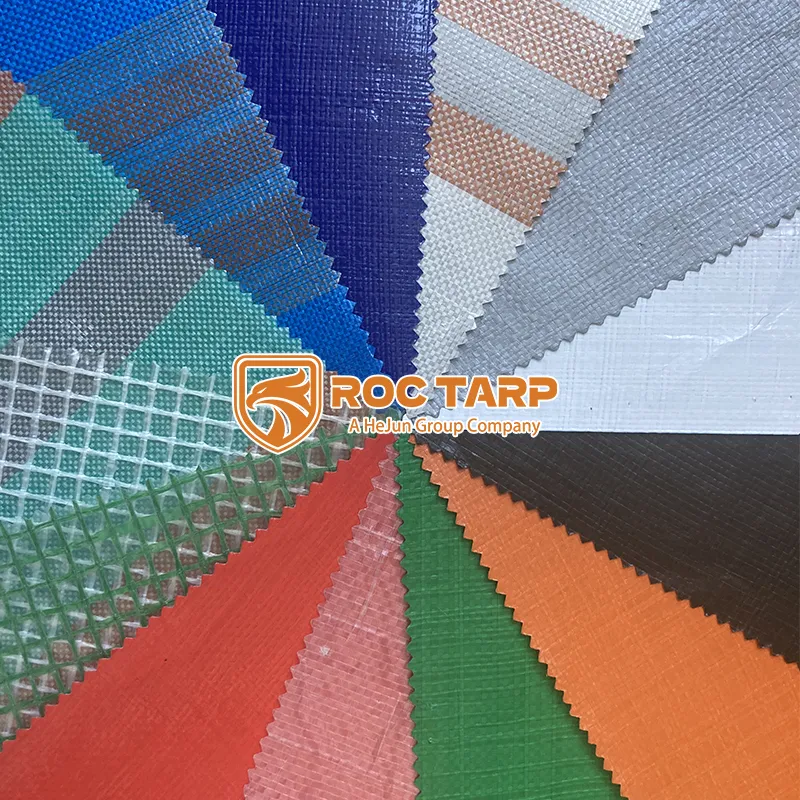
This is the smallest keyword set of any page on this site and one of the most valuable, because the people searching it are growers, nurseries and horticultural suppliers — buyers who order by the container and reorder every season. It is also the most ambiguous keyword in the catalogue. The same three words are used for the film that covers a greenhouse, the sheet that blacks one out, and the cloth that goes on the ground under the benches. We make two of the three, and this page is mostly about telling them apart.
That distinction is not pedantry. A glazing film and a tarp differ by a factor of three per square metre, and by everything else that matters: what they let through, how they shed snow, and how they fail. A tarp sold to do a film’s job comes back as a complaint within one season, and the complaint will be about light.
1. Three different products answer to “greenhouse tarp”
|
Glazing film |
Shade / blackout sheet |
Ground / protection sheet |
| Job |
Let light in, hold heat, shed snow |
Keep light out; cut heat; cover an empty house |
Separate, cover, protect |
| Made by |
Blown film, 6 mil, 4-year UV package |
Woven and coated PE |
Woven and coated PE |
| Light |
80–90% transmitted |
Effectively none |
None |
| Sold by |
The mil (thickness) |
The GSM and the size |
The GSM and the size |
| Ours |
No |
Yes |
Yes |
The film is what most people mean. It is translucent, it is what you see on a commercial tomato house, and it is bought on a four-year replacement cycle from film extruders. We do not make it, we cannot laminate it, and we have no reason to pretend otherwise — see the next section for why a woven sheet cannot stand in for it.
The shade or blackout sheet is a woven, coated fabric used precisely because it does not transmit light. It goes over the film, or over a frame with no film at all, when the grower wants less light: summer heat, photoperiod control, or a house standing empty between crops. This is our product, and it is the reason this page exists.
The ground sheet is the least glamorous and the one that reorders most reliably. It goes under benches, along walkways, under gravel and between beds, to stop weeds and to keep moisture where it belongs. Nurseries buy it by the roll, season after season, because it wears out in the sun and because they keep expanding.
There is a fourth thing people mean, and it is worth naming: the sheet you throw over the house after a storm. Torn film, a bent hoop, three weeks before the crop is due — nobody plans for that purchase and nobody compares specifications when they make it. If that is you, skip to §7 and tell us the span; a solid sheet is the right answer and the exact weight is not the question that day.
2. Why a woven sheet is not glazing — and when it is still the right sheet
A 200 GSM PE tarp transmits no usable light. Not “a little less” — in a double-layer laminated weave with black or white pigment on both faces, the sheet is a wall. Seedlings under one stretch, yellow and drop leaves within a week, and no amount of ventilation fixes it, because the problem is the roof and not the air.
Weight is not the argument, though people expect it to be. A 20 × 40 ft sheet at 200 GSM weighs about 15 kg; the same area of 6 mil film weighs about 10 kg. Half again as heavy is not what breaks a frame. What breaks a frame is snow, and that is the real difference between the two products.
Film is smooth, taut and slightly glossy, so snow slides off a pitched or arched house before it accumulates. A woven sheet is textured, sits on the same frame with more friction and, once a layer of snow has gripped it, stops shedding. A foot of settled snow on a 20 × 40 ft roof is somewhere between 1.5 and 4.5 tonnes depending on how wet it is. Hoop frames in the horticultural trade are engineered against the film’s shedding behaviour, not against a sheet that holds the load. If you are covering a house that will stand through a winter with snow, say so when you enquire: the answer may be “not this sheet”, and it is better to hear that now.
So when is a woven sheet the right answer over a greenhouse? Four cases, and they are all cases where blocking light is the point:
- The house is empty. Between crops, during refurbishment, over winter when the structure stands but nothing grows. You want the UV off the film and the frame, and you want the inside dark so algae and weeds do not get a season for free.
- You are controlling day length. That is §3, and it is the most technical use on this page.
- You need heat out, not light in. A white or black sheet over the roof in a heatwave is cruder than shade paint and it is removable, which paint is not.
- Something has failed. Storm, hail, a torn gable. A tarp buys you the two weeks you need to get film delivered, and it is the only purchase on this page that is made in a hurry.
One thing we will not do is sell a tarp as “translucent”. If your enquiry says translucent, you want film, and the honest answer is that we are the wrong supplier — a woven sheet with holes in it (the leno range) is a shade product, not a glazing one.
3. Blackout: the job where the seams decide everything
Chrysanthemum and poinsettia are short-day crops. Growers flower them out of season by covering the house for part of every day — pulling a blackout sheet over the crop in the late afternoon and opening it in the morning — so the plant sees a short day whatever the calendar says. The sheet has to do one thing absolutely: leave no light in. Not “mostly dark”. None.
This is where a tarp is genuinely good and genuinely limited at the same time. The body of a black laminated sheet blocks light completely, and it does so for years. But a blackout house is not judged by its body — it is judged by its edges and its seams, and those are exactly the parts where a hem-and-eyelet sheet leaks:
- Every eyelet is a hole. A 12 mm eyelet at 24 in centres is a row of light points along the whole sheet. Growers who have built blackout from tarps describe a strip of plants near the wall that flowers late — that is the eyelet row, not the fabric.
- A stitched seam is a pinhole line. Our seams are welded, which closes them, but a seam is still the first place a sheet is pulled, flexed and eventually parted.
- The gutter is where blackout houses fail. Two sheets meeting at a gutter need a real overlap — a foot, not an inch — and the lower sheet has to be weighted or tied, because a blackout sheet that lifts four inches in a gust is a light leak that shows up as a delayed crop three weeks later.
Practical specification for a blackout panel: black, 200 to 250 GSM (heavier hangs straighter and flaps less), welded seams, a folded hem rather than a raw edge, eyelets only where you actually need them — the fewer the better — and a plan for the perimeter that does not rely on the sheet being airtight, because it will not be. A sheet is a panel; a blackout system with tracked edges, overlapped joints and a drive mechanism is a different product from a different industry, and we do not make it.
The other half of blackout is heat. A closed black house in July is an oven: the sheet absorbs instead of reflecting, air movement stops, and internal temperature climbs far past ambient. Blackout is a morning-and-evening operation with the house opened in between, not a summer-long cover. Growers know this; buyers new to the crop often do not, and it is worth saying in the quotation.
4. Shade: we have one grade, and it is about 30%
Shade is the request we have to answer most carefully, because it is the one where our range is narrowest. Our shade product is woven leno mesh at roughly 30% shade (70% light transmission) in white and green. That is a nursery grade: it takes the edge off summer sun over container stock, seedlings and young transplants without stalling growth.
Above 30% we have nothing to offer. Shade cloth at 50, 70 and 90% is warp-knitted, which is a different machine and a different product, and it is what most of the horticultural trade actually buys. If your enquiry says 70% shade, the correct answer is a shade-cloth mill — the leno page explains why the two fabrics cannot be substituted for each other.
There is also a cheaper answer than any fabric, and it is worth knowing before you buy. If the goal is temperature rather than light, shade paint or whitewash on the film does the job for a fraction of the cost and is standard practice in Mediterranean and Middle Eastern production. Fabric earns its price when you need the shade removable — early season, late season, or over a frame with no film at all — or when you are shading plants standing outdoors, where there is no film to paint.
5. Ground sheets and windbreak: the two uses that are pure tarp
Nursery ground sheets are the most straightforward sale on this page and the one that repeats. Black PE at 8 to 10 mil — about 190 to 240 GSM — goes under benches, along walkways, under gravel yards and between container beds. Its jobs are weed suppression, moisture retention and a clean surface to work on. Specify it to the area plus 6 inches of lap on every joint, and accept that the sun will take it in three to five seasons — a ground sheet is a consumable, not a capital item, and pricing it as one is how nurseries actually buy it.
The one decision worth flagging: on a surface that stays wet, a woven geotextile drains where a coated sheet traps water and turns the ground under it soft. Under gravel in a wet climate, cloth is the better product; on dry, compacted yards a coated sheet is cheaper and does the same job. We make the coated sheet, and we will say which of the two your site wants.
Windbreak is the use where the specification is counter-intuitive. A solid barrier does not stop wind, it deflects it: the flow goes over the top, curls back down behind the barrier, and the turbulence on the leeward side is harder on plants than the open wind was. What works is a permeable barrier — something that takes 40 to 50% of the wind’s energy out and lets the rest through, which spreads the reduction over a distance of ten barrier heights instead of dumping an eddy at the base. Our 30% shade leno is at the very open end of that range: it is a good light windbreak for nursery beds, sand blast and salt spray, and it is not a structural windbreak for an exposed site. For that, you want a knitted 50% net, and it is not ours.
6. Sizes: measure the arc, not the width
The most common sizing error on this product is quoting a cover the width of the house. A hoop house is not a box. For a semicircular arch the fabric has to run the arc length, which is about 1.57 × the width, plus whatever straight wall the house has at the base. A 20 ft wide hoop needs roughly 31 ft of fabric across before you add legs — a 20 ft cover will not reach the ground on either side, and the gap is at exactly the height where wind gets in.
Give us the width, the leg height and the arch shape and we will do the arithmetic with you. What we need for the quotation is the finished size including the overhang you want at the base, because the overhang is what you tie down and it is the first thing to tear if it is short.
The second sizing fact is the seam count, and it follows from our single-piece widths of 2.0 m and 4.0 m. Read the panel counts against the finished cover width, not the house width: a cover 16 to 24 ft across is two panels and one seam, which is where a hoop up to about 15 ft wide lands once the arc is added; a 20 ft hoop runs 31 ft across and is three panels and two seams; 40 ft is four. Put the seams along the short dimension of the house, where they are cheapest to make and easiest to check, and remember that the panel count is why a 40 ft house is not priced as two 20 ft houses.
Weight per piece is small enough that it decides packing, not structure:
| Weight |
A 20 × 40 ft sheet (74 m²) |
Sheets per 5 t |
What it suits |
| 150 GSM |
About 11 kg |
About 450 |
Ground sheets, one-season shading, emergency cover |
| 200 GSM |
About 15 kg |
About 330 |
The workhorse: blackout panels, ground sheets, general cover |
| 250 GSM |
About 19 kg |
About 270 |
Blackout that has to hang straight and not flap |
| 300 GSM |
About 22 kg |
About 225 |
Exposed sites, reusable covers, windbreak panels |
At 200 GSM, 5 tonnes is about 330 sheets of 20 × 40 ft — which is the number that tells you who this page is for. It is a nursery chain, a horticultural distributor or a grower with several hectares under cover, not someone covering one tomato house in a garden.
One warning about the phrase “heavy duty greenhouse tarp”. On a greenhouse it usually means “thick enough not to tear”, and the buyer thinks of film thickness. On our sheets the number that matters for tearing is the same GSM, but the number that matters for the frame is the one above: heavier sheet, more snow held, more load on the hoops. If the house is in a snow area, heavier is not safer.
7. Ordering, and the five things we do not make
Minimum order is 5 tonnes, and 5 tonnes per specification for a custom size, colour or eyelet pattern — specifications do not combine. Lead time is about 30 days for a container of standard material. Samples are free and you cover the courier; for blackout work ask for a piece of the actual black you are quoting, because “black” ranges from a dense matte to something that lets a grey glow through when held to the sun, and that difference matters at 5 a.m. in a chrysanthemum house.
Five things we will not quote, and it is cheaper for both of us to say so here:
- Glazing film. Blown polyethylene film, 6 mil, four-year UV package, sold by the mil. Different process, different suppliers, and the product most people mean by “greenhouse tarp”.
- Fleece and frost blanket. Spunbond non-woven protects a crop by trapping air; a coated sheet laid on plants does the opposite — it conducts cold and freezes to the leaves. We do not make non-woven, and a tarp is the wrong tool for frost.
- Knitted shade cloth at 50–90%. Warp-knitted, different machine, and the bulk of the horticultural market. Our shade tops out at about 30% in leno.
- Blackout systems. Tracks, rails, drive mechanisms, curtains with welded edges and designed overlaps. We supply the panel; the system comes from a greenhouse equipment supplier.
- Frames, hoops, hardware. Poles, clamps, ropes, tensioners, fixings — the structure side of a greenhouse is a different supply chain, including the “free standing” frames people search for. We supply the sheet that goes on the frame.
For the material itself, the PE range explains what the grade words mean; shade at the open end is the leno range; ground sheets for outdoor beds and yards sit alongside the garden and landscape range. Cutting, welding and eyeleting are on the cutting and heat sealing page and the eyelet and finishing page. If you are specifying a cover for a structure rather than a crop, the carport and shed range is closer to what you want.