A roofing tarpaulin is the only cover in this catalogue that is designed to be pierced. On a silage stack, a truck load or a pool, the entire job is to keep holes out of the sheet. On a roof you drive fasteners through it, because the alternative is a sheet that disappears in the first gust. That one fact changes the weight, the hem, the eyelet spacing and the price — and it is where most roof enquiries go wrong before the fabric is even chosen.
1. The only tarp you nail through, and why that decides the specification
There is a real contradiction on a roof. Fasten lightly and wind takes the sheet. Fasten heavily and you have put a few dozen holes in the one thing that was meant to keep water out. The trade settled this a long time ago, and the answer was not a better fabric — it was a strip of wood.
The sheet is trapped under a furring strip, and the fasteners go through the strip, through the sheet and into the deck. The nail hole is then covered by the strip that made it, and the load is spread along the strip instead of tearing out one eyelet at a time. This is how the US Army Corps of Engineers installs temporary roofs under Operation Blue Roof: fibre-reinforced polyethylene sheeting, 1×2 furring strips, a galvanised nail every 24 inches along the run of each strip, and strips every 6 feet. Not a clever membrane. A board and a nail pattern.
Two rules follow, and they are the two things that most often go wrong on a DIY cover.
Do not fasten through the part that has to stay watertight. Fasteners belong outside the damaged area, on sound decking, and never through a ridge vent, a chimney, a skylight curb or a plumbing boot. Sheeting over a flue is worse than leaving it open — a blocked flue can send combustion gas back into the house, and a covered vent traps moisture where it cannot dry. Cut around them and tape the cut edge.
Do not rely on eyelets for the primary hold. Eyelets are excellent for rope and are the right answer when you tie a sheet over a load. Under wind load on a roof, one eyelet carries more than a reinforced hem was ever sized for. The strips hold the sheet; the eyelets only control the edges.
So the first question on a roof enquiry is not how big. It is how it is going down, because the four usual answers lead to four different specifications.
Four ways to hold a sheet down, and what each one costs you
| Method |
Penetrates the roof? |
Holds for |
Use when |
| 1×2 furring strip + nails |
Yes, through deck |
Months, in wind |
Standard roof cover — the Blue Roof method |
| Cap nails, 12 in pattern |
Yes, at every cap |
Weeks to months |
Small repair, speed matters more than deck damage |
| Weighted tube or sandbag |
No |
Days to weeks |
Membrane, standing seam, listed buildings |
| Eyelet and rope to a frame |
No |
Hours to days |
Temporary hold, or a sheet tied over a skip |
Only the first line needs the heavier sheet and the reinforced hem. The other three are tension-limited, not fastener-limited, which is why a ballasted cover on a light sheet performs worse than the fabric suggests — it cannot be pulled tight, so it flaps.
2. Why roof area × 1.5 still comes up short
Sizing a roof cover looks like arithmetic and is really four corrections stacked on top of each other. Miss any one of them and the sheet is short at the ridge, which is the one place you cannot fix afterwards. A roof tarp calculator is doing nothing more than these four lines.
| Correction |
What it takes |
Why |
| Nominal vs actual |
3–6 in per side |
A “20×30” is cut from 20×30 stock and then hemmed, so the usable sheet is nearer 19 ft 6 in × 29 ft 6 in |
| Pitch |
×1.054 to ×1.414 |
4/12 multiplies plan area by 1.054, 6/12 by 1.118, 8/12 by 1.202, 12/12 by 1.414 |
| Over the ridge |
at least 4 ft past it |
The sheet has to be anchored on the far slope, not balanced on the peak |
| Anchor margin |
3–4 ft on every side |
You need sound material to fasten into, and slack to fold under the strip |
Two rules of thumb circulate and both are right, for different jobs. Local repair: measure the damage and add 3–4 ft to every side. Whole slope: take the surface area × 1.5, which absorbs the ridge wrap, the eaves and the waste in one number. Neither corrects for the hem, which is why the answer is always to round up to the next size.
Worked example: a 12 × 30 ft damaged section on a 6/12 roof. Adding 4 ft on every side gives 20 × 38 ft, about 760 ft² of plan — and at 6/12 that is roughly 850 ft² of slope. Rounded up that is a 20 × 40, not a 20 × 30: the difference between a covered roof and a second trip up the ladder. For a whole roof the count matters more than the arithmetic. A 1,500 ft² footprint at 6/12 is about 1,680 ft² of surface, which is three 20 × 30 sheets with nothing to spare, or two 30 × 50 sheets with one ridge lap and one fewer seam to tape. Fewer and larger is almost always the better buy, because the seams are where it fails — and a 30 × 50 is heavy enough that two people will want a plan for getting it over the eave.
A roof with valleys, dormers or a chimney in the field is not a rectangle, and those are cut to drawing rather than bought as a standard large roof tarp. Send the plan with the obstructions marked, and we will lay the panels out and tell you where the seams land before you commit.
3. Thirty days is the standard, not the limit
The most useful number on this page comes from a government programme. Operation Blue Roof, run by the US Army Corps of Engineers under FEMA mission assignment after named storms, has covered thousands of roofs, and the sheeting it installs is specified to protect a roof for a minimum of 30 days. That is not a fabric limit — it is what the programme promises a homeowner before permanent repairs. It tells you something concrete: 30 days of cover is achievable with a mid-weight reinforced PE sheet and a 24-inch nail pattern.
The programme is equally clear about the other side: the sheets are not warrantied, and removing the fasteners afterwards will leave leaks. Both are honest statements about what a nailed sheet is. It is a temporary roof — the question worth answering is how long temporary has to be for you.
| How long it must last |
Sheet |
Fixing |
What changes |
| 30–90 days, storm response |
PE 120–180 GSM, UV stabilised |
1×2 strips, nails at 24 in |
Nothing — this is the Blue Roof baseline |
| One season, repair delayed |
PE 200–260 GSM, UV stabilised |
Strips at 4 ft, nails at 12 in |
Weight for abrasion, tighter pattern for wind |
| Over a year, roof in use |
PVC 475–745 GSM on polyester, light colour or held off the deck |
Strips at 4 ft, welded hem, eyelets at 12 in |
Different material — but see the temperature limit below |
The honest split: PE is right for a season and wrong for three years. PVC costs roughly two to three times as much per square metre, and in published outdoor-exposure data the material class reaches five to ten years against one to three for PE. That is a figure for the polymer, not a warranty on a sheet — what a given cover does depends on where it is and how it is fixed. If a roof will be open for a year — a reroof waiting on a permit, a church, a barn, a shed holding machinery — PVC is cheaper per month even though it is more expensive per sheet. The PVC range covers that trade-off properly.
One limit comes with PVC and it is not negotiable. Our PVC is rated to about 70 °C continuous contact. A dark roof deck in summer runs 30 to 40 K above air temperature, so a 70 °C surface is routine rather than exceptional in a southern summer. A dark PVC sheet laid flat on that deck has no margin: the plasticiser migrates, the sheet stiffens, and the first cold snap after a hot summer is when it cracks. PVC on a roof therefore means a light colour, or an air gap under the sheet, or a job where the cover comes off before the deck heats through. If the cover is staying on a dark deck through July, the answer is a light-coloured PE, not PVC.
For buyers in storm markets: a hurricane cover is the same product bought under a deadline. Nothing about the sheet changes because a storm has a name — what changes is that there is no longer time to correct a size. That is why distributors on the Gulf and in the Caribbean stock whole-roof sizes before the season rather than after the forecast, and why we ship those as container loads in the months before landfall.
4. Wind, not water, is what removes a roof tarp
Sheets rarely fail because rain came through them. They fail because a loose edge lifted, filled with air and tore out its fasteners — usually at a corner or along the eave, where uplift is highest and where the sheet has the least material behind it. Two things decide whether that happens, and neither of them is the fabric; a third option avoids fasteners altogether.
Tension. A sheet with slack is a sail. Every fold that can catch air will catch air. Pull it flat down the slope before fastening anything, and start at the high edge, not the low one — a sheet positioned from the bottom always ends up short at the ridge.
Fastener spacing at the perimeter. The interior of a sheet sees far less load than its edges. Nails at 24 inches along the strips is the baseline; at corners, along the eave and on any exposed gable, halve it. In a hurricane zone, halve it again and add a cross strap.
Ballast instead of fasteners. Buyers ask for this when the roof is a membrane, a standing-seam metal roof, or a listed building where new holes are unacceptable. Weighted tubes along every edge do work, but be honest about what it is: a days-to-weeks measure, not a seasonal one. A ballasted sheet cannot be tensioned, so it flaps, and every flap works the coating at the fold until it cracks.
Two structural notes. On a mobile home or a thin metal roof there may be nothing behind the panel to fasten into; the fix is a strip spanning two rafters, screwed at both ends, with the sheet trapped underneath. And on a flat roof the limit is not wind but standing water — ten millimetres of rain is ten kilograms per square metre, so a large flat cover holds tonnes, which is the pooling problem and is solved with slope or a drain, not a heavier sheet.
A leak diverter tarp is a different item again: a shaped sheet hung inside the building to catch water and lead it into a bucket or a hose. It needs a formed seam and a fitting at the low point, and we do not make it — what we supply is flat sheet. If you need one, it is a fabricated product and a fabricator will price it faster than we will.
5. The other roof tarp: tear-off and debris
There is a second product in this category that a homeowner never sees and a roofer buys every month: the tear-off tarp. When a roof is stripped, everything that comes off — shingles, felt, nails, staples — lands on a sheet laid on the ground or in a skip, and that sheet has to survive being dragged, loaded, hooked by nail points and folded wet at the end of the day.
A roofer’s tarp for this job has almost the opposite specification to an emergency cover. It does not need a UV package, because it spends most of its life folded or under debris. It does need abrasion resistance and tensile strength, because it is dragged across concrete and lifted by four corners. It needs eyelets that will take a hook, and it needs to be repairable, because a roofer patches rather than replaces. A 200–300 GSM PE sheet with reinforced corners and eyelets on 3 ft centres does that job, and leaving out the UV additive is what makes it affordable enough to own six of them.
It also gets used off the roof — screeding, container tops, machinery during a stripping job. If you supply roofers or builders’ merchants rather than homeowners, this is usually the item with the repeat order in it.
6. Blue, white, black — and what each one does on a roof
Blue is the colour of roof cover in North America half by accident and half by repetition. The masterbatch is cheap and hides dirt, so blue became the retail default, and then a federal programme put it on thousands of roofs after every storm and fixed it in the public mind. It is worth knowing when a buyer in another market asks why the same roofing tarps are white in his country and blue in yours: nothing physical changed. The PE range covers where the colour convention came from.
What does change is temperature. A dark sheet in direct sun absorbs most of the solar spectrum and runs measurably hotter than a white or silver one, which reflects the visible band. Heat and ultraviolet are the two things that kill a coating outdoors, and on a roof the sheet sits flat against a hot deck with no airflow behind it, so the difference is not cosmetic. For anything that must last a season or more in a hot climate, white or silver is the better specification and blue is the cheaper one. Black is for covering debris, where hiding stains matters more than surface temperature.
| Grade |
GSM |
mil |
Roof use |
Indicative life |
| Light |
50–90 |
2–4 |
Dust cover, a dry week, debris on a patio |
weeks |
| Standard |
120–180 |
5–8 |
Storm response, one repair cycle |
30–90 days |
| Heavy |
200–260 |
8–11 |
A season, windy sites, tear-off and debris |
3–12 months |
| PVC |
475–745 |
— |
Over a year, in a light colour, or off the deck |
several years |
The mil column is GSM ÷ 23.88 — a translation, not a second specification, because two sheets at the same mil can carry different coating weights. Quote GSM. The life column is a material-class figure for normal exposure, not a warranty: a slack sheet in wind dies in months at any GSM. For the long version of the weight argument — what 200 GSM buys that 120 does not, and where the grade names come from — the heavy duty guide covers it.
Widths decide the seam count, and this is where a quote stops being a price per square metre. Single-piece widths are PE 2.0 m and 4.0 m, PVC 3.2 m, 4.0 m and 5.0 m. A 30 × 50 ft sheet is 9.14 m across: in PE that is three panels and two lengthwise welds; in PVC it is two panels and one. Same finished size, different construction, different price — which is why the seam count belongs in the quote and not in the small print.
Everything else that decides the sheet:
| Property |
What we work to |
| Weight range |
50–300 GSM (PE) · 475–745 GSM (PVC) |
| Construction |
3- or 5-layer PE, coated both faces · PVC on woven polyester |
| Primary fixing |
1×2 furring strip, fasteners through strip and sheet · eyelets for edge control only |
| Edge |
Heat-welded hem · brass eyelets through reinforcement patches at 600 mm (24 in) standard, 300 mm for roof work |
| Seam |
Heat-welded only. No sewn seams, no webbing loops, no zips on this range |
| Colour |
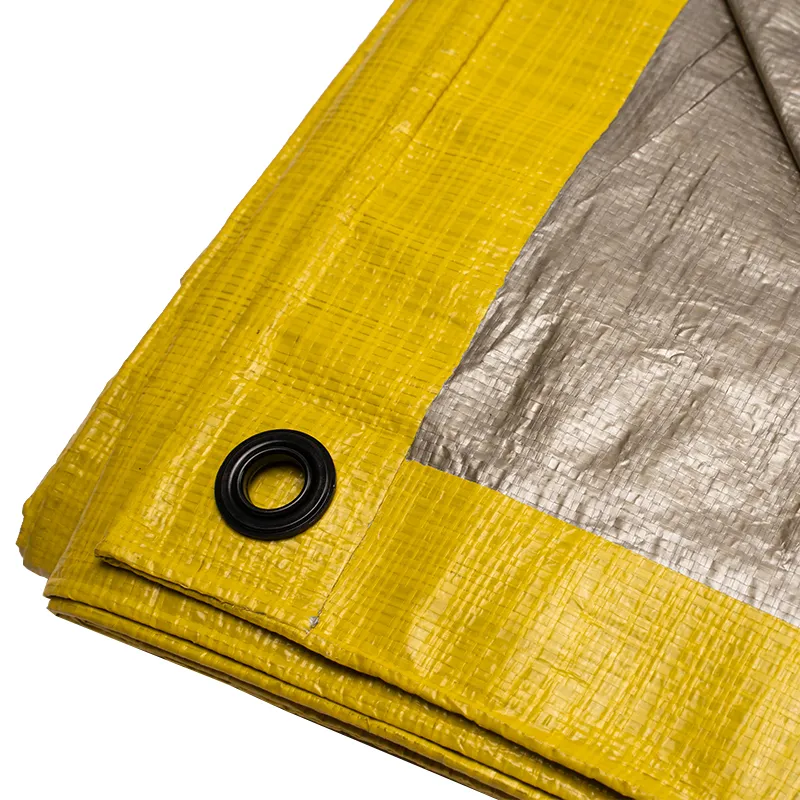
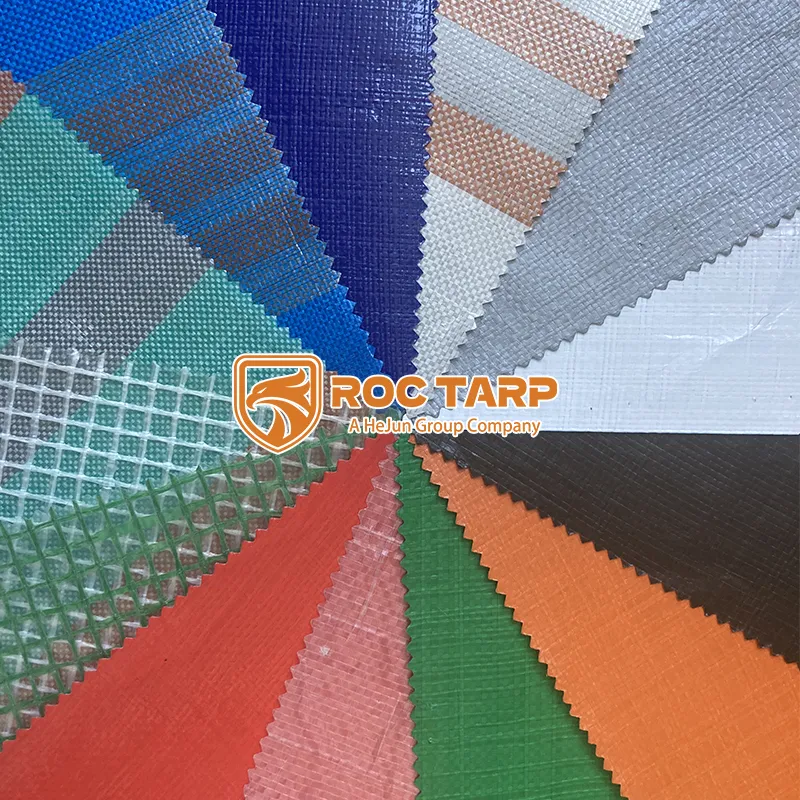
Silver/yellow, white, blue, black, green (PE) · black, white, grey (PVC) |
| UV option |
Stabilised for exposed cover · UV package omitted on tear-off sheets |
| Minimum order |
5 t standard · 5 t per specification for custom colour, width or print |
| Lead time |
About 30 days per container · 30–45 days for two or more · PVC about 45 days |
Samples are free and you cover the courier — for a roof enquiry ask for a hem and eyelet sample as well as a swatch, because on this product the edge is what gets tested first.
7. Building enclosure tarps and temporary roofs over scaffolds
A vertical sheet is not a roof sheet stood on its side. Hanging fabric takes wind load across its whole area instead of shedding it down a slope, so a building enclosure tarp is specified for the highest pressure the site will see rather than for the average week: closer eyelets, a stronger hem, and a bottom edge that is fixed rather than left to flap.
Two things matter more than the fabric. The sheet has to breathe or be vented at the top, or condensation runs down the inside face and the enclosure becomes a wet room. And the width has to match the scaffold bay, because a lap in the middle of a bay is exactly where wind will start. Our 4 m PE width covers most bay spacings without a joint, which removes both the lap and the labour.
For a temporary roof over a scaffold — one with a fall and a fixing detail — the rules are the same as on a building roof: 4 m widths cut the number of laps, the laps land on the beams, and a light colour stops the structure below from being heated from above. This is where the enclosure and the roof cover converge on the same specification, and it is usually the same buyer ordering both.
8. What tarping a roof costs, and which part we sell
That phrase carries two very different prices, and almost everything you find online is the second one. An emergency roofing crew charges for labour, access equipment and post-storm demand; the sheet inside that price is a small fraction of it. This is why the cost to tarp a roof quoted by a contractor and the cost of a cover ex works differ by an order of magnitude, and why comparing them tells you nothing.
We sell the sheet, by the container, FOB. So our number is per square metre at a given weight, width and edge specification, and it moves with four things: weight, colour, whether the hem is welded with a rope core, and how many pieces you want the sheet cut into. A 20 × 40 in one piece and four 10 × 20 pieces cover the same area and are not the same price — in PE the single sheet carries one lengthwise weld, while the four pieces carry none but twice the hem length and four corner sets to reinforce.
We supply the sheet. We do not install, and we do not run an emergency call-out — if you need someone on a roof tonight, we are the wrong call. If you are the homeowner rather than the buyer, the step-by-step is in our emergency roof cover guide: this page is about what to buy, that one is about getting it up before the next band of rain.